
Managing Food Allergies
Welcome to JMU
JMU Dining is committed to providing nutritious options that fit our students' needs. We support students with food allergies by providing the knowledge and resources necessary for them to make empowered food choices in our dining locations.
Our goal is to provide students with the tools and support that they need to utilize the dining halls safely while being active in the management of their food allergy/allergies or food-related medical condition(s).
We take into account each individual student's personal dietary needs and make every effort to help students transition into their new life at James Madison University. GO DUKES!
Your Management
You are the most important advocate for your own health. Please review your responsibilities when managing a food allergy in our dining locations.

Connect With Our Health & Wellness Manager
Learn how to navigate our dining halls with ease. Reach our Health & Wellness Manager, Hanna Serrano, at serranhb@jmu.edu.

Consult With the Office of Disability Services
Visit www.jmu.edu/ods for additional accommodations, if necessary.

Be proficient in the self-management of your food allergy/allergies or food-related health condition(s)
- Avoid foods to which you are allergic.
- Recognize the symptoms of allergic reactions.
- Know how and when to tell someone that you may be having an allergy-related problem.
- Know how to properly use prescribed medication(s) to treat an allergic reaction.
- Carry emergency contact information with you.

Direct questions about ingredients to our registered dietitian, chef(s), or ask any manager on duty.
If you do not know who these individuals are, please ask a cashier to contact the chef or manager on duty to assist you.

In case of exposure, carry your medication (ex. EpiPen) with you at all times.
Consider informing friends you normally dine with about your medical needs in case of an emergency. Please Note: JMU Dining has stock epinephrine at our residential dining locations (D-Hall & E-Hall) as an emergency precaution. You should carry your prescribed medications with you at all times.


Your Resources
An Individual Meeting with Our On-Site Registered Dietitian
Meet with our registered dietitian to develop an individualized plan to navigate the residential dining facilities.
The Chef(s) & Manager(s) on Duty
The chef(s) and/or manager(s) on duty are available in our dining locations to address on-site questions and concerns.
Access to Manufacturer Provided Ingredient Labels and Nutrition Information
Contact our dietitian about specific products you are interested in reviewing or ask for a chef at the location to discuss ingredients.
Fresh Gloves, Utensils, or Pans
Upon request employees at made-to-order stations will use separate equipment (when applicable) to reduce cross-contact concerns.
Access to the Worry-Free Zone
The Worry-Free Zone is an isolated, locked pantry stocked with peanut-free, tree nut-free, and gluten-free products. Students who are medically required to limit or avoid these food items should reach out to our registered dietitian to gain access.
Additional Resources
If you are not receiving a diverse selection of food from the available resources, you may consult with our registered dietitian to discuss whether additional supports are necessary.
Menu Icons
Menu icons found on online and in-person menus can be a helpful tool for navigating dietary restrictions.

Plant Forward
A style of cooking and eating emphasizing healthy plants at the center of the plate. May contain a proportionally small quantity of animal protein.

Made With Whole Grains
Whole grains are a leading ingredient in this item.

Vegetarian
Contains no meat, fish, or poultry.

Coolfoods Meals
Certified climate-friendly by the World Resources Institute. They have a low impact on the climate, making them a delicious way to help the planet.

Vegan
Contains no animal products of any kind.

Made Without Gluten
*Selections made with ingredients that do not contain gluten.

Eat Well
Lower in calories, saturated fat, and sodium AND at least one full serving of nutritionally dense ingredients like vegetables, lean protein, whole grains or fresh greens.




*Please Note: Foods prepared without gluten containing ingredients may not be “gluten-free” as recipes are prepared in open kitchens where cross-contact is possible. Aramark relies on its manufacturers’ ingredient listings in determining whether an ingredient contains gluten.
Know The Lingo
Knowing the resources in our dining locations will make your dining experience a breeze!

True Balance
True Balance stations (D-Hall & E-Hall) omit the top 9 food allergens and gluten. The menu items served at this station are prepared in a dedicated space using dedicated equipment by employees who have completed allergen and gluten-free training.
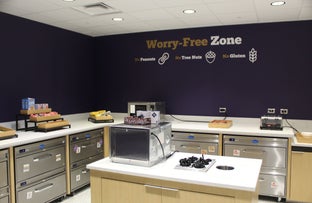
Worry-Free Zone
The Worry-Free Zone is a locked pantry room stocked with peanut-, tree nut-, and gluten-free products located in D-Hall. Students who are medically required to limit or avoid peanuts, tree nuts, and/or gluten should reach out to our Health & Wellness Manager to discuss access requirements.
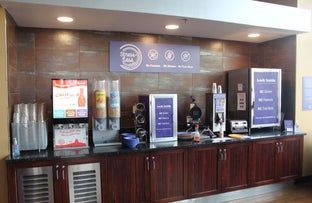
Stress-Less Corner
The Stress-Less Corner is a self-serve station that offers items made without peanuts, tree nuts, and gluten. Open to all.


Allergy Information

Fish Allergies
Entrées with fish as an ingredient are occasionally on the menus. Some dishes may also contain fish sauce, Worcestershire sauce, curry paste, or Caesar dressing.

Peanut Allergies
Peanut oil is used at Chick-Fil-A. Other dining locations use a vegetable oil blend for frying and cooking. Peanuts are often used in our bakeries. Students with peanut allergies are advised to take caution with bakery items.

Shellfish Allergies
Entrées and soups with shellfish as an ingredient are occasionally on the menu.

Tree Nut Allergies
Tree nuts have been removed from menu items at D-Hall, E-Hall & proprietary brands. National brands may still serve tree nuts. JMU Dining follows the FDA’s definition of allergens, so coconut is still utilized.

Sesame Allergies
Sesame is found in the hummus served daily at multiple locations across campus including the deli stations. Sesame bagels are served at breakfast at multiple locations on campus.

Soy Allergies
JMU Dining uses oil that contains soybeans for cooking and frying. However, this oil is refined and excludes the protein in soy that causes allergic reactions. We consider this oil safe for students with soy allergies.

Milk Allergies
Milk alternatives (such as soy, oat, and almond) are available throughout campus including our residential and retail locations. Many bakery and manufactured products may contain milk as an ingredient.

Egg Allergies
Eggs are often present in baked goods and mayonnaise. Students with egg allergies are asked to take caution with baked goods. Take caution with deep-fried foods, which may have been fried with recycled oil used to fry food items coated with egg.

Wheat Allergies
*Made without gluten cereal and grains are available daily and made without gluten bread, buns, and pizza crust are available upon request at multiple locations across campus. A variety of gluten free products are available at our convenience store locations.


*Please Note: Foods commonly prepared without gluten containing ingredients may not be “gluten-free.” Our recipes are prepared in open kitchens where cross-contact is possible and where ingredient substitutions are sometimes made. Aramark relies on its manufacturers’ ingredient listings in determining whether an ingredient contains gluten.
FDA Allergy Update
The Food & Drug Administration no longer classifies coconut or mollusks (like clams, mussels, and oysters) as major allergens. That means manufacturers don’t have to list them as allergens, and our menu may not display coconut as a tree nut or mollusks as shellfish. These ingredients may still be used in some dishes.
Please contact our dietitian (serranhb@jmu.edu) if you have questions.